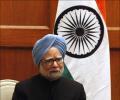
Experts say it will now be tough for the Modi government to catch up with the UPA's economic record owing to the shock induced by the currency demonetisation.

Changes the base year and included more sectors.

Corporate indebtedness is now twice what it was before the global financial crisis; banks' bad loans ratio is 3.5 times higher.

How should one billion Indians, for whom deprivation has become an inescapable way of life, join us in celebrating 75 years of Independence? And where do we go from here? asks Kalyan Singhal.

Education finance is a complex and dynamic sector. There are too many variables -- the course, the calibre of students, the universities, and the job prospects once the course is over, notes Tamal Bandyopadhyay.
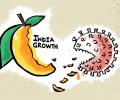
The economic growth may have slowed to 3.5 per cent in fourth quarter of 2021-22 from 5.4 per cent in the previous three-month period due to the impact of higher commodity prices on margins, decline in wheat yields and on higher base, Icra Ratings said on Monday. The agency said the hiccups in the recovery of the contact-intensive services attributable to the third wave of Covid-19 in the country may have also affected the economic growth in the quarter. Even the gross value added (GVA) at basic prices (at constant 2011-12 prices) in Q4 FY2022 seems to have eased to 2.7 per cent from 4.7 per cent in Q3 FY2022, it said.
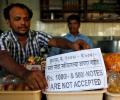
India Inc said policymakers should take doable steps to revive fixed investments and production of capital goods

'We should look at is full year's growth rather than quarter numbers.'

During the first quarter ended June, gross tax collections fell 31 per cent driven down by a massive 76 per cent plunge in advance tax mop-up, as the country was in a full lockdown due to the pandemic.

The biggest headwind to the consumption story in FY23 is a sharp decline in government subsidies on food, fertiliser and fuel, and overall decline in revenue expenditure net of interest payments. This, analysts say, will adversely impact purchasing power of households at the lower end of the income pyramid, translating into lower spending on consumer goods and services.

However, Icra Rating Principal Economist Aditi Nayar feels that the numbers are a bit too optimistic and need real heavy-lifting by the Centre and the states. "The survey forecasts on real and nominal GDP will require a substantial push from Central and state spending as private sector capacity expansion is anticipated to be intermittent, and sector-specific in the next couple of quarters," she said. Nayar added that private consumption is likely to chart a differentiated recovery across income and age groups. Based on the comments made in the Survey, she expects the Union Budget to incorporate a growth in gross tax revenue of 15-16 per cent.

'Given that the economy is going through a slowdown, further downward revisions of the 2019-2020 growth estimates cannot be ruled out,' notes A K Bhattacharya.
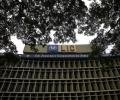
At a closed-door meeting with global investors, the largest asset manager in the country boasted of its nearly Rs 37 trillion assets under management (AUM) - 16.6 times that managed by the second-largest insurer SBI Life. The numbers are as of March 31, 2021. The assets of LIC are 1.2 times the net assets of the entire Indian mutual fund industry, which had AUM of Rs 31.43 trillion as of March 31, 2021 (about Rs 37.3 trillion until November this year). The standalone assets that LIC manages are equal to 18.7 per cent of India's GDP and worth more than gross domestic product (GDP) of the UAE, Bangladesh, Malaysia, Singapore, Hong Kong, South Africa, New Zealand, and Pakistan.

The Reserve Bank's growth projection for next financial year is lower than 8-8.5 per cent projected by the finance ministry in the recent Economic Survey which was tabled in Parliament on January 31. Unveiling the bi-monthly policy, RBI governor Shaktikanta Das said, "Recovery in domestic economic activity is yet to be broad-based, as private consumption and contact-intensive services remain below pre-pandemic levels."

'The most important priority for the next 25 years should be to strengthen our democracy so that it is supportive of social harmony, and to not just respect but to take pride in the diversity of Indian society in terms of the variety of languages, religion and religious practices and social norms,' explains Nitin Desai.

To do so, the government will have to tackle a number of broad development challenges successfully, says Shankar Acharya

India's equity markets are on a roller-coaster ride, after delivering spectacular returns for two consecutive years - in 2020 and 2021. The benchmark National Stock Exchange's (NSE's) Nifty50 is down 1.5 per cent in the first nine months of the current calendar year 2022 (CY22) as foreign portfolio investors sold Indian stocks due to rising bond yields in the US and across global markets, including India. The sell-off in the Indian equity markets has, however, not been broad-based and largely limited to sectors facing earnings headwinds from rising interest rates, lower commodity and energy prices, and likely economic recession in advanced economies.

The estimates of national income and growth do not pass the 'smell test'.

Lenders can now initiate recovery proceedings since the SC has lifted the standstill on asset classification, which protected stressed accounts from slipping into NPAs.

Only one of the three drivers of the economy has performed in the way it should: government spending grew at 15.6 per cent, reports Abhishek Waghmare.

Leading economists have pencilled in a high 13-15.7 per cent uptick in the economy in the first quarter of 2022-23 with an upward bias. Soumya Kanti Ghosh, the group chief economic adviser at State Bank of India, on Tuesday said he expects the GDP to clip past 15.7 per cent in the first quarter with more chances of the final numbers printing in higher, while Aditi Nayar, the chief economist at the rating agency Icra, said the economy will grow much lower at 13 per cent in the June quarter. The national statistical office will announce the first quarter GDP numbers later next week.

In India, air pollution is most severe in the Indo-Gangetic Plain (northern India), where topography and meteorology concentrate pollution from energy, mobility, industry, agriculture, and other activities, the researchers said.
It has Rs 20,500 crore of standard stressed pool outstanding as of June 2018. Thus, the entire stressed book (net NPAs and standard stressed pool) is nearly two times its net worth.

'Given the 50 per cent or thereabouts increase in borrowing that has been announced, it is a reasonable estimate to say that at this time, an increase of 1.7-1.8 per cent on the 3.5 per cent budgeted fiscal deficit target is being anticipated,' Chief Economic Adviser Krishnamurthy Subramanian said on Friday.

... As the world swings from 'financialisation' to 'artificial intelligence', asks Ajit Balakrishnan.

Various indicators make it amply clear that there are grave challenges facing the new government of Chief Minister Nitish Kumar, reports Indivjal Dhasmana.

With decline in number of fresh COVID-19 cases and easing of restrictions, the country's gross domestic product (GDP) will grow at 8.5 per cent in FY2021-22, according to credit rating agency Icra Ratings. It expects the gross value added (GVA) at basic prices (at constant 2011-12 prices) to grow at 7.3 per cent in FY2022. "The impact of the second wave of COVID-19 and the ensuing state-wise restrictions was seen across a variety of high frequency indicators in April-May 2021.

Budget for 2022-2023 has returned to its agenda for protectionism in the name of creating a self-reliant India, points out A K Bhattacharya.

China's post COVID-19 pandemic economic rebound showed signs of slowdown as the economy grew at 7.9 per cent in the second quarter compared to a record 18.3 per cent in Q1, while the GDP expanded 12.7 per cent year on year in the first half amid the continued global spread of the coronavirus and unbalanced domestic recovery. In the second quarter, the GDP of the second largest economy in the world grew 7.9 per cent year on year, the data released by the National Bureau of Statistics, (NBS) on Thursday showed. On a quarterly basis, the economy expanded 1.3 per cent in Q2.

Macroeconomic management is usually a lot more comfortable with lower fiscal deficits. The sooner we get there, the better for the economy, says former Chief Economic Adviser to the Government of India Shankar Acharya.

The decline is attributed to lower salary growth and a rise in households' financial liabilities.

It is sad that the legislative pre-consultation on such an important bill is being done in a very biased manner, notes Shailesh Gandhi, former Central Information Commissioner, recounting his experience with Minister Rajeev Chandrashekhar.

Germany was the fourth best place for older people to live.

After contracting for two quarters in a row, the Indian economy entered the positive territory with a growth of 0.4 per cent in the October-December quarter, mainly due to good performance by farm, services and construction sectors, official data showed on Friday. Trade and hotel industry registered a contraction of 7.7 per cent during the third quarter this fiscal, as the sectors continued to suffer on account of coronavirus pandemic. According to the data released by the National Statistical Office (NSO), the farm sector recorded a growth of 3.9 per cent, and the manufacturing sector output grew by 1.6 per cent in the quarter under review.

Maharashtra's "radical" lockdown move will have an economic impact of Rs 40,000 crore, with the trade, hotels and transport sector to bear the biggest dent, Care Ratings said on Monday. The rating agency said the loss of economic activity will have a 0.32 per cent impact on the gross value added (GVA) growth at the national level. It revised down its national GDP growth estimate to 10.7 - 10.9 per cent from the 11 - 11.2 per cent given a week ago. Maharashtra has been contributing nearly 60 per cent to the daily COVID-19 infections nationally and had over 57,000 new cases on Sunday.
The sudden stop in economic activity led to a sharp decline in employment-intensive sectors like construction, manufacturing and trade, hotels, transport etc.
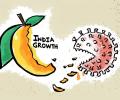
The Reserve Bank on Wednesday retained the GDP growth forecast at 9.5 per cent for the current fiscal but cautioned that the economic recovery is not yet strong enough to be self-sustaining and durable.

India also fares poorly on maternal mortality rate.

Earnings growth in the early-bird sample has been driven by banks and iron & steel companies.

RBI Governor Shaktikanta Das kept the red flag on cryptocurrencies flying, warning that the next financial crisis can be triggered by private cryptocurrencies if such speculative instruments are allowed to grow.
 © 2026 Rediff.com - Advertise with us - Disclaimer - Privacy Policy - Sitemap - Feedback - About us - Terms of use - Grievances